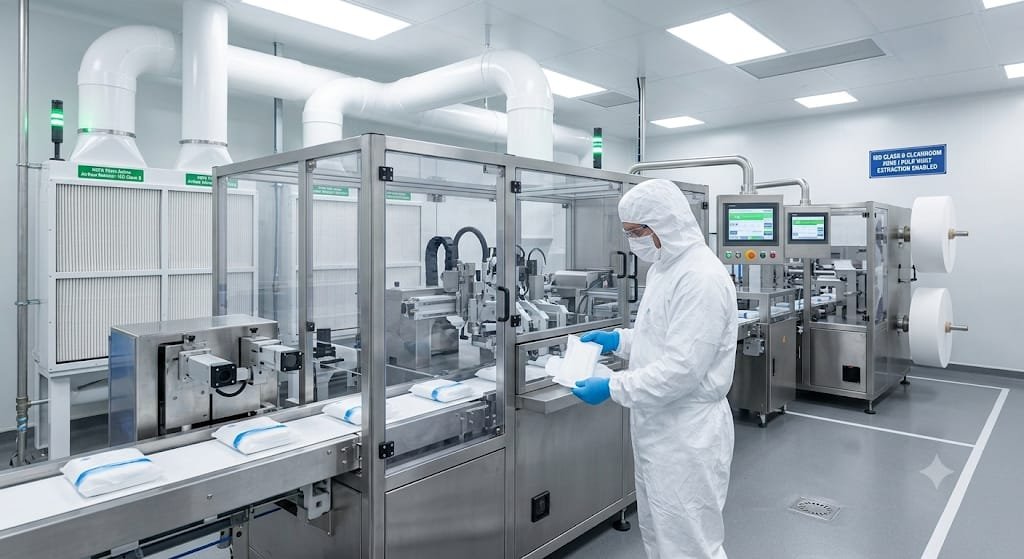
Essential engineering guide to factory floor planning, ISO cleanroom compliance, dust extraction systems, and utility requirements for high-speed feminine hygiene production lines
Establishing a compliant sanitary napkin manufacturing facility demands strict adherence to hygiene standards, dust mitigation, and streamlined material workflow. Operating high-speed conversion machinery requires a well-planned facility layout to maximize output and meet international quality benchmarks.
Cleanroom Classification & Air Quality:
Production zones should operate under ISO Class 8 (Class 100,000) cleanroom conditions or positive pressure hygiene enclosures.
Continuous air filtration with AHU (Air Handling Units) maintains controlled humidity (< 55\% RH) to prevent SAP agglomeration and static buildup.
Pulp Dust Extraction Systems:
High-speed fluff formation generates airborne pulp particles that affect machine bearings and optical inspection sensors.
Centralized cyclone dust collectors
with multi-point suction hoods at the fiberization unit are mandatory for worker safety and line uptime.
Utility & Power Sizing:
Electrical Supply: Stable 3-phase power (415\text{ V}, 50/60\text{ Hz}) with dedicated servo-line stabilizers to prevent drive synchronization errors.
Compressed Air: Continuous supply at 6–8\text{ bar} with dedicated refrigerated air dryers to remove moisture before reaching pneumatic valves and web guides.
Material Flow & Anti-Contamination Zoning:
Implement a strict unidirectional workflow: Raw Material Receiving \rightarrow Production & Sealing \rightarrow Online Auto-Packaging \rightarrow Quarantine & Finished Goods Warehouse.
Dedicated personnel air showers and gowning stations prior to entering the core converting area.